
CarbonCity: a prototype observing system for the continuous measurement of city-scale carbon dioxide net emissions
PIANO NAZIONALE DI RIPRESA E RESILIENZA (PNRR)
Missione 4 “Istruzione e Ricerca” - Componente C2
Investimento 1.1, “Fondo per il Programma Nazionale di Ricerca e Progetti di Rilevante Interesse Nazionale (PRIN)”
Codice progetto: 20225ER4TR
CUP: E53D23004240006
Contributo MUR per Ricerca: 190.384
Cofinanziamento Ateneo/Ente: 26.640

Partners
- Università degli Studi dell'AQUILA (Coordinatore), Responsabile: Gabriele Curci
- Consiglio Nazionale delle Ricerche, Responsabile: Giampietro Casasanta
Brief description and main objectives
With the Race to Zero greenhouse gas emissions by 2050 of the worldwide community, there is an urgent need to define effective and timely protocols to objectively monitor and report the net emissions at the national and subnational level. In this framework, urban areas are going to play a key role, since they host about 50% of the human population and drive the global production and consumption, with an increasing outlook over the next decades.
The CarbonCity proposal is aimed at developing and demonstrating the application of an accurate, reliable, affordable prototype observing system, which is able to continuously monitor the net CO2 emissions at city-scale with near-real-time update and long-term stability.
The CarbonCity proposal is aimed at developing and demonstrating the application of an accurate, reliable, affordable prototype observing system, which is able to continuously monitor the net CO2 emissions at city-scale with near-real-time update and long-term stability.
The monitoring stations provide eddy-covariance flux and concentration measurements of CO2, they are movable in order to experiment different spatial configurations, and equipped with low/intermediate cost devices. At least one will be located in the urban core and at least two outside, in order to estimate the excess CO2 from the urban area. The inversion framework is primarily based on an as-simple-as-possible mass-balance box model.
The CarbonCity project has the potential to provide the municipalities with a convenient and reliable tool for monitoring the trend of carbon dioxide emissions inside the city and may give citizens a tool for constant information on their climate altering emissions.
Main results and publications
The activity of the project aimed at achiving the main goals are four. Here below the specific objectives and the related main results achieved during the execution of the project:
O1) Definition of the observing system accuracy and precision required to detect trends of city-scale CO2 net emission trends of the order of -3%/year in less than 5 years
Deliverable 1 - The ideal observing system uncertainty requirement would be of the order of 10% in estimating monthly emissions, so that a race-to-zero -3%/year emission reduction trend would be detected in less than 5 years. If this uncertainty increases to 20%, then the required number of years would increase to about 9 years.
O2) Comparison and assessment of different observational strategies (e.g. location and number of instruments) through Observing System Simulation Experiments (OSSE) aimed at estimating terms of the budget of CO2 mass within a city-scale box in the planetary boundary layer
Deliverable 2 – A column model was devised and applied to available data at the European scale. The intermediate application of the model to the datasets in France and Switzerland showed that the method may in principle be applied using a pair of stations at the opposite sides of the city, with the emission retrieval possible when the stations are one downwind of the other.
O3) Assessment of the accuracy and precision of low- and intermediate-cost instruments aimed at the measurements of CO2 concentrations in the planetary boundary layer and CO2 fluxes from sources near the surface
Deliverable 3 – Very low-cost sensors were excluded from further analysis, as they require too extensive calibration to achieve reasonable accuracy and precision. Intermediate-cost sensors were reviewed and the main observational setup characterized. This activity defined the final setup of the instruments developed in CarbonCity, namely a triaxial sonic anemometer and simplified IRGA system for measuring CO₂ concentrations and fluxes.
O4) Deployment and testing in real conditions of at least one demonstrative observing system which is able to provide reliable data to estimate net CO2 emissions from at least one pilot city within the design uncertainty, at least at biweekly frequency and for at least 6 months
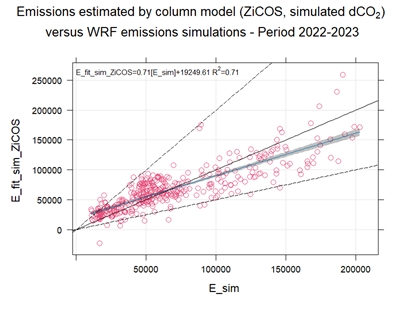
Deliverable 4 – Using intermediate-cost observations in Zurich in combination with an inverse column-model developed using WRF-CO2 simulations, we selected sites located along a NE–SW direction, NE wind direction for both sites, wind speed greater than 3 m/s, and PBL < 1200 m at the central site; the concentration difference calculated from hourly data, selected according to the criteria devised in Deliverable 2, allows the estimation of CO₂ emissions with low relative uncertainty. The relative standard error (SE/m × 100) of less than 2% indicates that the annual mean may be estimated with sufficient precision to detect possible trends in less than 5 years.
The following two first publications are in preparation:
- Amarillo, A., Curci, G. Casasanta, G. Sozzi, R., “Feasibility study of a prototype observing system for the continuous measurement of city-scale carbon dioxide net emissions”
- Casasanta, G., Sozzi, R. Alberici, A., Amarillo, A., Curci, G., “A Low‑Cost Platform for City‑Scale CO2 flux Monitoring: Design and Preliminary Validation.”
O1) Definition of the observing system accuracy and precision required to detect trends of city-scale CO2 net emission trends of the order of -3%/year in less than 5 years
Deliverable 1 - The ideal observing system uncertainty requirement would be of the order of 10% in estimating monthly emissions, so that a race-to-zero -3%/year emission reduction trend would be detected in less than 5 years. If this uncertainty increases to 20%, then the required number of years would increase to about 9 years.
O2) Comparison and assessment of different observational strategies (e.g. location and number of instruments) through Observing System Simulation Experiments (OSSE) aimed at estimating terms of the budget of CO2 mass within a city-scale box in the planetary boundary layer
Deliverable 2 – A column model was devised and applied to available data at the European scale. The intermediate application of the model to the datasets in France and Switzerland showed that the method may in principle be applied using a pair of stations at the opposite sides of the city, with the emission retrieval possible when the stations are one downwind of the other.
O3) Assessment of the accuracy and precision of low- and intermediate-cost instruments aimed at the measurements of CO2 concentrations in the planetary boundary layer and CO2 fluxes from sources near the surface
Deliverable 3 – Very low-cost sensors were excluded from further analysis, as they require too extensive calibration to achieve reasonable accuracy and precision. Intermediate-cost sensors were reviewed and the main observational setup characterized. This activity defined the final setup of the instruments developed in CarbonCity, namely a triaxial sonic anemometer and simplified IRGA system for measuring CO₂ concentrations and fluxes.
O4) Deployment and testing in real conditions of at least one demonstrative observing system which is able to provide reliable data to estimate net CO2 emissions from at least one pilot city within the design uncertainty, at least at biweekly frequency and for at least 6 months
Deliverable 4 – Using intermediate-cost observations in Zurich in combination with an inverse column-model developed using WRF-CO2 simulations, we selected sites located along a NE–SW direction, NE wind direction for both sites, wind speed greater than 3 m/s, and PBL < 1200 m at the central site; the concentration difference calculated from hourly data, selected according to the criteria devised in Deliverable 2, allows the estimation of CO₂ emissions with low relative uncertainty. The relative standard error (SE/m × 100) of less than 2% indicates that the annual mean may be estimated with sufficient precision to detect possible trends in less than 5 years.
The following two first publications are in preparation:
- Amarillo, A., Curci, G. Casasanta, G. Sozzi, R., “Feasibility study of a prototype observing system for the continuous measurement of city-scale carbon dioxide net emissions”
- Casasanta, G., Sozzi, R. Alberici, A., Amarillo, A., Curci, G., “A Low‑Cost Platform for City‑Scale CO2 flux Monitoring: Design and Preliminary Validation.”
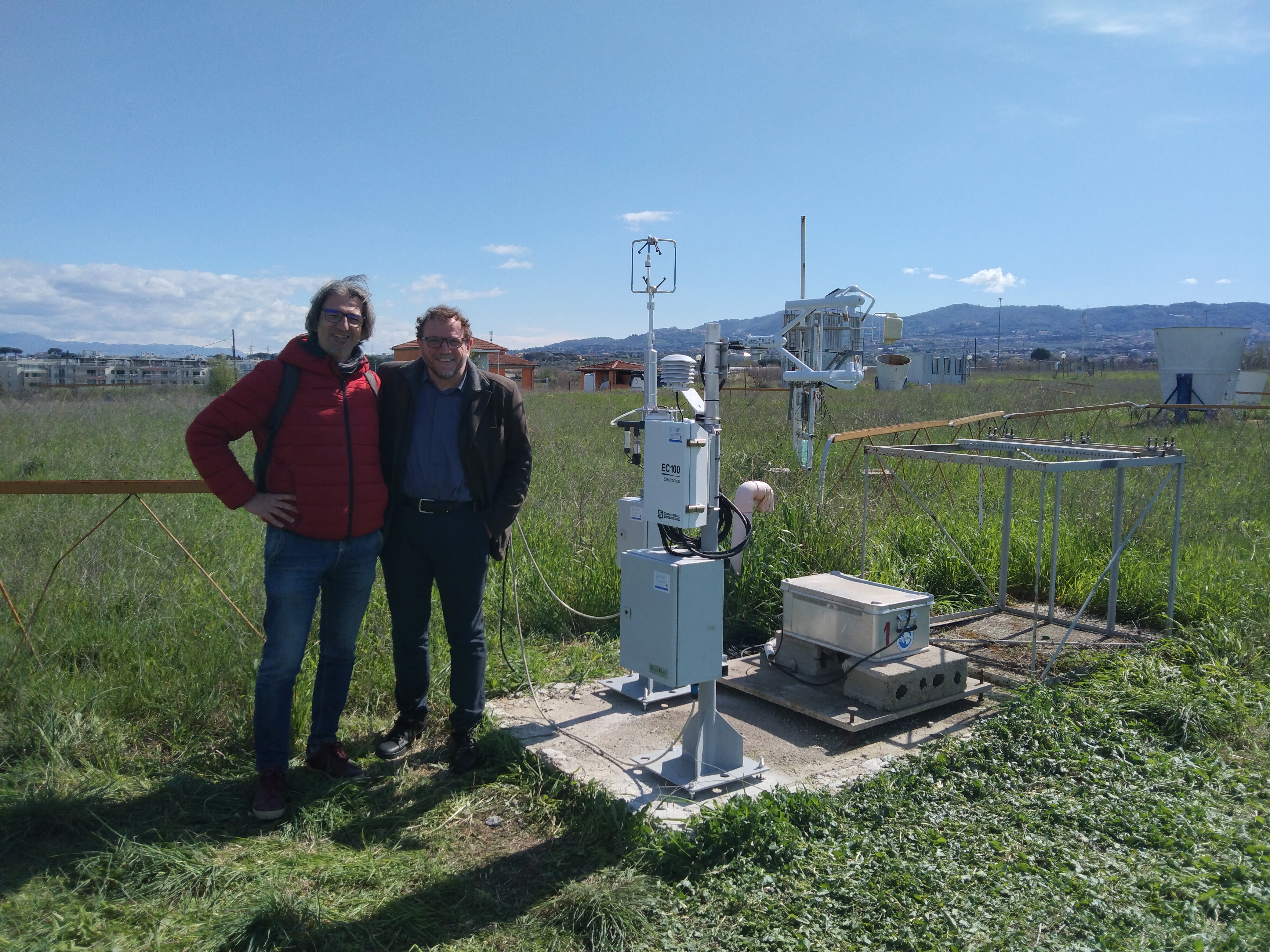
Observing systems developed during the project, at test site of CNR-ISAC in Rome
OSSE CO2 emissions from the city of Zurich estimated with the column inversion model developed in the project